BCSB Serial crystallography at the ALS
The BCSB and ALS are developing serial crystallography for ligand screening and time-resolved experiments as a capability at Gemini beamline 2.0.1, in collaboration with the Kern, Brewster, and Weber groups. Users can contact beamline staff to run experiments on a trial basis as the technique becomes standardized.
Approach
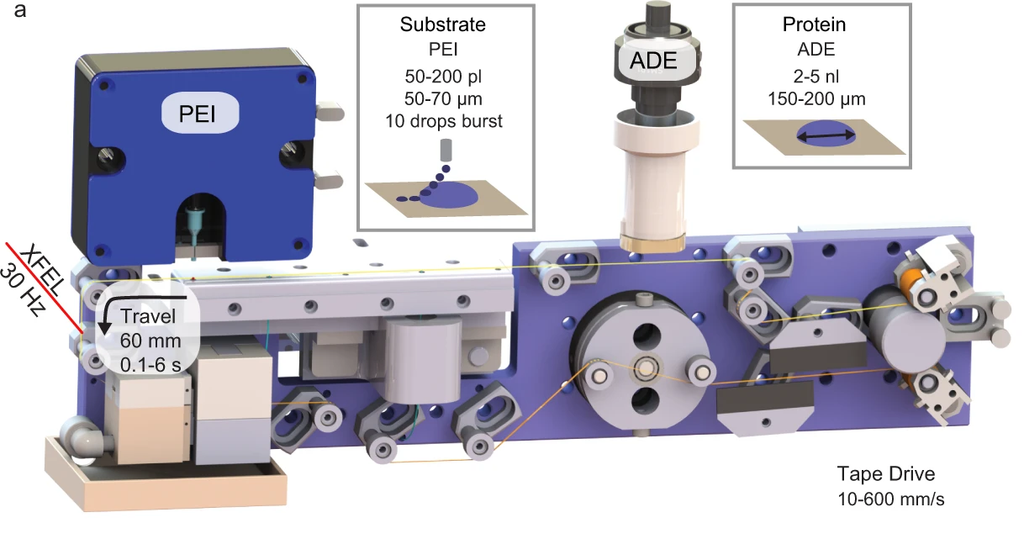
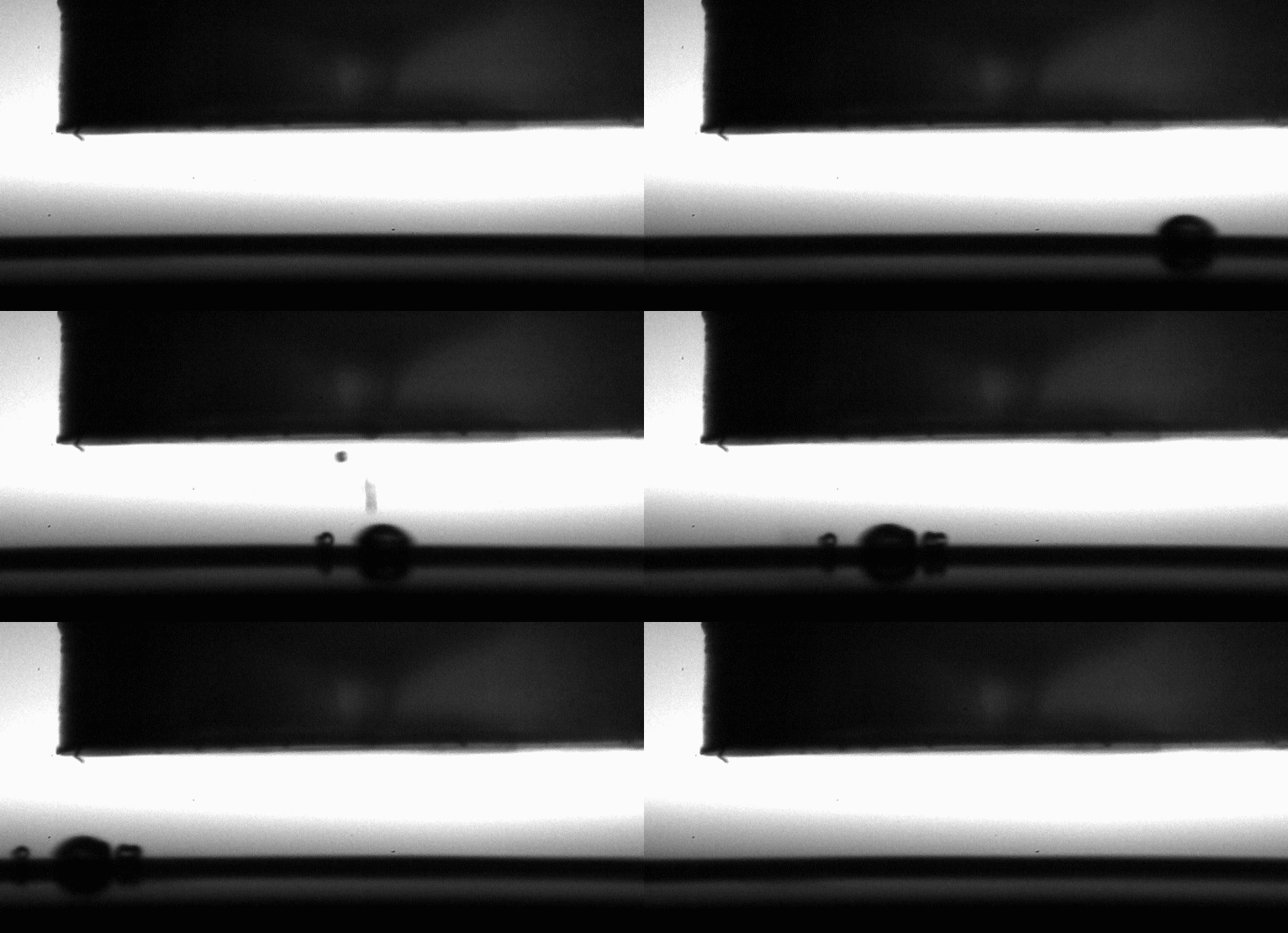
We use a tape drive sample delivery system: a suspension of crystals are ejected as droplets onto a Kapton tape, which moves the droplets to a second injector which injects tiny droplets of substrate/ligand. Rapid diffusion enables ligand binding as the droplets move to the X-ray beam (here marked as XFEL, but usable at synchrotrons as well).
Sample requirements
A single dataset typically requires 3000 to 10000 indexed images, which depending on the hit rate (number of indexed images as a percent of the total images collected), can take 3 to 15 minutes to collect. Given typical flow rates of 12 microliters per minute of sample and ligand, sample consumption can be from 30 to 200 uL. For example:
| Dataset size | Hitrate | Collection speed (images per second) | Dataset time (minutes) | Sample and ligand consumption @ 12 uL/min (ul) | Sample consumption for lysozyme, @ 14.4 kDa, ~1.75 mM (mg) |
| 3000 | 10% | 100 | 10 | 120 | 3 |
| 3000 | 20% | 100 | 2.5 | 30 | 0.75 |
| 10000 | 10% | 100 | 17 | 200 | 5 |
| 10000 | 20% | 100 | 8 | 100 | 2.5 |
For more detail and to consult about possible experiments, please contact beamline staff (Daniil Prigozhin, DaniilPrigozhin@lbl.gov).
References
Butryn A. et al. (2021). “An on-demand, drop-on-drop method for studying enzyme catalysis by serial crystallography.” Nat Commun 12, 4461. https://dx.doi.org/10.1038/s41467-021-24757-7