
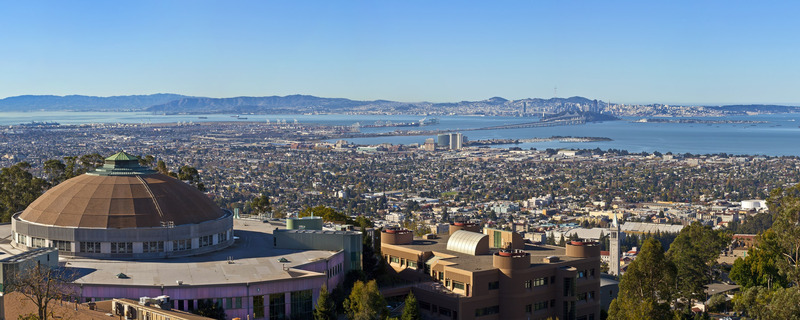
Panorama of Lawrence Berkeley National Lab – looking out to San Francisco Bay from the Advanced Light Source

Upcoming user beam schedules as of 6/8/2026

  • 2026-2 Cycle (July–December): No beam in the second half of 2026. The ALS will shut down in early July through the end of the calendar year for the replacement of the switch station through which all power for the ALS accelerator comes.
  • 2027-1 Cycle (January–June): Several months of beam, anticipated to begin in January. Accumulator ring commissioning will require a month-long period in the spring without user operations. Following this, continued accumulator commissioning will require approximately six weeks of reduced user operations. During that time, the ALS will be shut down for approximately four days per week. The detailed cycle schedule will be announced in fall 2026.
  • 2027-2 Cycle (July–December): At least three months of beam, depending on final dark time start date. We will not have an extended shutdown in summer 2027. Detailed schedule anticipated in spring 2027.
  • Dark time: Dark time is planned to start no earlier than October 2027 and will last approximately 22 months.

For inquires please contact BCSBbeamtime@lbl.gov

Beamlines

The BCSB runs six beamlines at the Advanced Light Source: Beamlines 2.0.1, 5.0.1, 5.0.2, 5.0.3, 8.2.1, and 8.2.2. You can read about the characteristics of the beamlines under the “Our Beamlines” link from the top menu. Beamlines 2.0.1, 5.0.2, 8.2.1 and 8.2.2 are tunable beamlines, while 5.0.1 and 5.0.3 are fixed wavelength at the Se edge. All beamlines are remote accessible.

Remote Access

Beamline staff will provide technical support and puck changes during onsite support hours only. If you lose significant time overnight, we will schedule make-up beamtime for you as soon as possible. Because we run 6 beamlines, it is generally not a problem for us to find you more time.  Please contact Stacey Ortega at 510-495-2450 to arrange make-up time.

Collaboration

Please note that the Collaborative Crystallography program is now run under the ALS-ENABLE program, found here. 

Over the last couple of years, advances in hardware and software have transformed protein crystallography into a standard technique for obtaining detailed structural information. In order to provide both expert and non-expert academic users more extended service, a Collaborative Crystallography program is available for non-proprietary users of the ALS crystallography lines.

Feel free to obtain more information by contacting either Dr. Banumathi Sankaran at BSankaran@lbl.gov. or Dr. Jay Nix at JCNix.lbl.gov. 

Citing Us
The Berkeley Center for Structural Biology is supported by the Howard Hughes Medical Institute, Participating Research Team members, and the National Institutes of Health, National Institute of General Medical Sciences, ALS-ENABLE grant P30 GM124169. The Advanced Light Source is a Department of Energy Office of Science User Facility under Contract No. DE-AC02-05CH11231. The Eiger detector on beamline 2.0.1 was funded under NIH grant 1S10OD032212. The Pilatus detector on beamline 5.0.1 was funded under NIH grant S10OD026941.