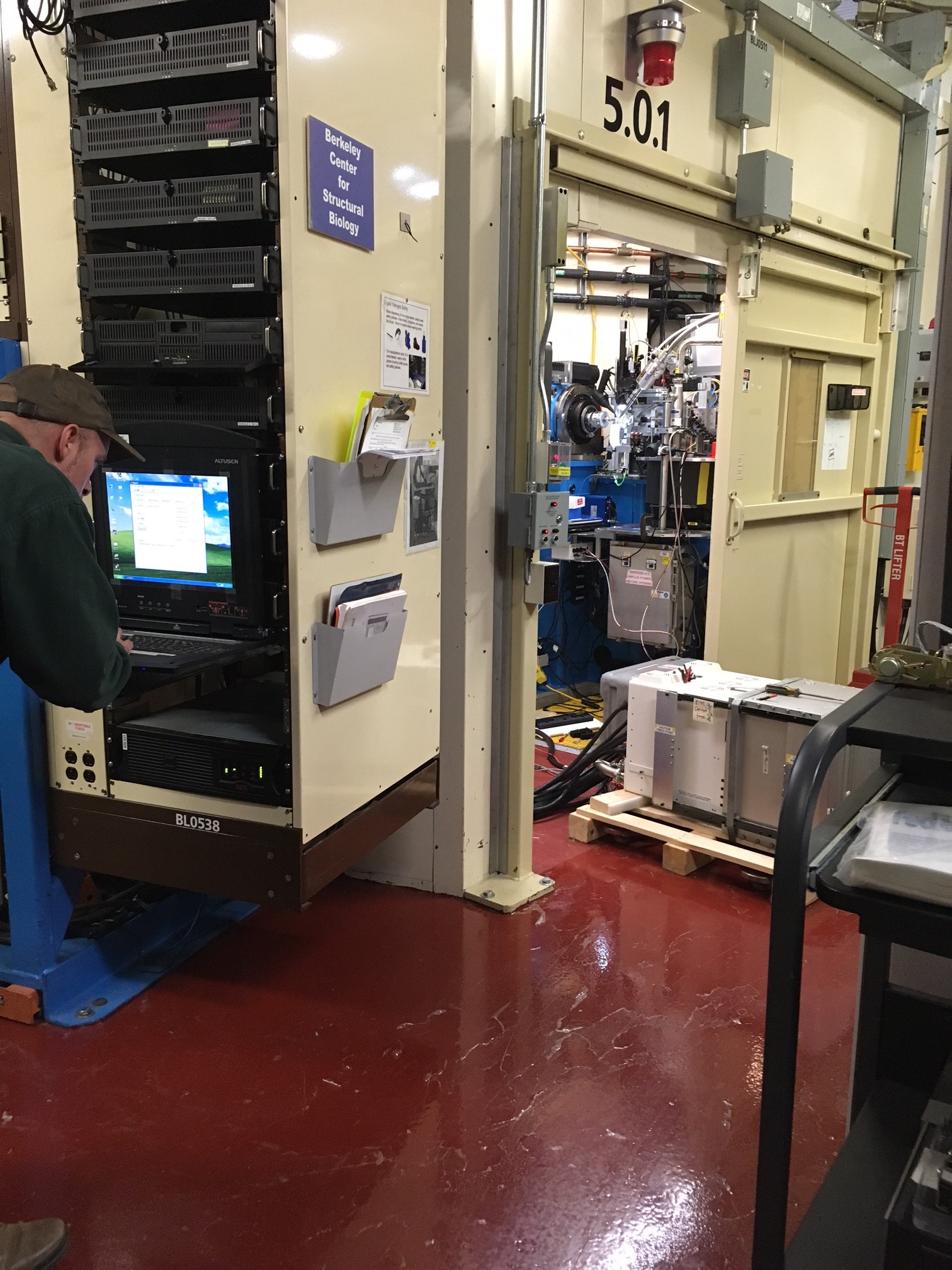
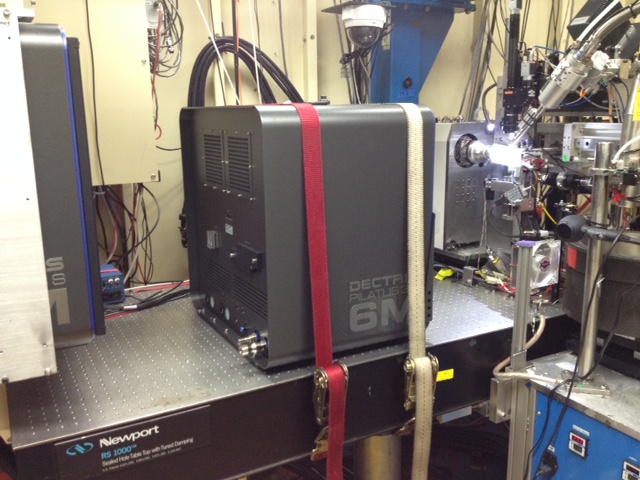
Pilatus on 5.0.2 has two new modules

Dectris was here at the ALS during the recent 2-bunch mode, and re-installed two of the modules on the Pilatus detector on beamline 5.0.2. Users may not have noticed, but the detector was previously missing panels on the far edges. These are now in good working order, and several test data sets have been collected successfully.
Similar Posts

  • Welcome to Daniil!

    We are very pleased to now have Daniil Prigozhin in the BCSB. He comes to us with a strong background in crystallography, both growing crystals and solving structures. He completed his PhD work with Dr. Tom Alber at UC Berkeley in 2014, then did a post-doc with Dr. Yorgo Modis at the University of Cambridge,…

  • Pin base warmer looking good

    We measured the temperature at the sample during warming of the pin base, and preliminary tests so far show that the heat is not transferred to the loop during two minutes of base warming. Tests are continuing now to determine how well the warmer removes ice and frost from the bases.

    Images of a crystal in a loop before and after using the pin base warmer:

    loop_before_base_warm

    loop_after_base_warm

  • BCSB User Forum

    The BCSB is planning on starting a monthly User Forum to solicit feedback from users on the current and future use of the beamlines. We’d love to hear from you about the direction that the BCSB should be taking in terms of beamline upgrades, features, and general operations. If you are interested in participating in the forum, please contact Corie Ralston.

  • Where have all the CCDs gone?

    During the January shutdown, we decided to test the two Q315R detectors that used to live in beamlines 5.0.1 and 5.0.2. Fortunately, they still work! Once Gemini is commissioned (at the end of this year, if all goes well) then we will have to take the Pilatus out of 5.0.1 and move it over to Gemini. Therefore, good to know that the Q315R is still good. Here it is being tested on the floor at 5.0.1.

  • a new SULI student at the BCSB

    A special welcome to our SULI student, Sayan Roychowhury, who is majoring in Electrical Engineering and Computer Science at the University of Illinois. He is here with us for the fall term, and writing code to process visual images of protein crystals and center them automatically in the x-ray beam. SULI is the Science Undergraduate Laboratory Internship program in which the host lab (in this case, LBNL) pays for a student to work for a few months to gain experience at a national lab and to encourage students to remain in STEM fields.

    Sayan_R_workin

  • Space Crystals

    Recently, Marc helped a user run some crystals which the user had arranged to have grown in zero-gravity. Here are pictures of the crystal capillaries mounted at the beamline, and the raster grid used to locate crystals within a capillary.